How Often Should You Reseal Travertine Floors in Phoenix, AZ
Travertine looks great, but it is porous and needs real protection. Here is the clear answer on how often to reseal travertine floors in Phoenix AZ, and a quick way to check if yours is ready.
If you have been wondering how often to reseal travertine floors in Phoenix AZ, the short version is every 1 to 3 years, and where your floor lands in that range depends almost entirely on sun, water, and foot traffic.
Many homeowners assume natural stone is bulletproof. We wish that were true, but travertine is a porous stone, and Arizona's climate does not go easy on it.
Here is the real schedule we see in thousands of Arizona homes, how to check your own floor in five minutes, and what happens if you skip resealing.
How often should you reseal travertine floors in Phoenix, AZ?
Most travertine floors in Phoenix-area homes should be resealed about every 2 years. Outdoor travertine, pool decks, and high-traffic areas usually need sealing every 1 to 2 years due to extreme heat, sun, and monsoon dust. If water soaks in within 5 minutes, reseal now.
How Often to Reseal Travertine Floors in Phoenix AZ? Everything You Need To Know
There is no one-size-fits-all rule for every home; any company giving you a specific timeframe without inspecting your floor is simply guessing. That said, here is the schedule we follow based on over 27 years of experience cleaning and sealing travertine in the Phoenix area.
Indoor travertine floors, normal use: seal approximately every 2 years. Frequent foot traffic and routine maintenance gradually wear down the protective layer.
Entryways, kitchens, and other high-traffic areas: seal every 1 to 2 years. Dirt and dust particles act like sandpaper underfoot, accelerating wear.
Outdoor travertine and pavers: seal every 1-2 years. UV, extreme heat and monsoon rain break down protection quickly. See our guide to choosing an outdoor travertine sealer.
Pool decks and water features: seal annually. Mineral-rich water, splashing, and pool chemicals quickly wear down the protection.
Showers and wet areas: seal every 1-2 years. Constant moisture absorption and mineral deposits (hard water) compromise the protective coating.
Commercial spaces: seal annually, or even more frequently. Heavy traffic and frequent cleaning shorten the treatment’s lifespan.
Grout lines follow their own timeline. A standard grout sealer protects for at least 2 years, while grout color sealing lasts much longer, protecting grout for roughly 7 to 10 years. If your tile and grout are due at the same time, it makes sense to handle both in one visit.
If both your tiles and grout need treatment, have them done at the same time. This will save you time and hassle.
The 5 Minute Water Test You Can Do Right Now
You don't need a professional to determine if your flooring needs a new treatment. All you need is a glass of water and five minutes.
Choose a high-traffic area, such as a hallway, the kitchen, or the pool deck.
Pour a small amount of water onto the travertine tile.
Wait five minutes and observe what happens.
Interpreting the results
The water beads up or stays on the surface: your protective coating is still effective. Repeat the test in six months.
The water soaks in, and the stone darkens within five minutes: the protection has worn off; it is time to call a professional to re-seal the surface.
The water soaks in almost instantly: the floor has likely been unprotected for some time. Start with a deep clean, as applying a sealer over embedded dirt would simply trap it beneath the surface.
Perform tests on several different areas. It is common for a hallway to remain well-protected while the flooring in the entryway or on the pool deck has already deteriorated.
This is perfectly normal; that is precisely why we assess the surface appearance and signs of wear on a per-area basis, rather than treating the entire house uniformly.
Why Arizona's Climate Changes the Answer
Travertine is naturally porous. This gives it its distinctive look, but it is also its weak point. In a temperate climate, a protective coating (sealer) might last three or four years. In Arizona, that is not the case.
Extreme heat and UV
The summer sun rapidly degrades protective coatings on outdoor surfaces. Unshaded patios heat up so intensely that the protection breaks down prematurely. This is the main reason why outdoor travertine requires more frequent maintenance than indoor flooring.
Monsoon season
Dust storms embed abrasive particles into the stone, which are then shifted around by the rain. This process erodes the surface and allows moisture to penetrate once the protective coating has worn away.
Mineral-rich water
The local water supply is hard (high in calcium). Sprinkler systems, pool splashes, and showers all leave behind mineral deposits. These accumulate on unprotected stone and dull its natural appearance.
Everyday household acids
Travertine reacts to acidic substances. Citrus, wine, vinegar and many off the shelf cleaners will etch the surface. It helps to understand the difference between alkaline and acid based cleaners before you buy anything.
Harsh chemicals are one of the fastest ways to strip a sealer early, which is why proper cleaning matters as much as the sealing itself.
What Happens If You Leave Travertine Unsealed
Damage isn't immediately visible, which is why people often put off the task. Deterioration is gradual, but by the time you notice it, you may need a full restoration rather than just a fresh coat of protective sealant.
Embedded dirt settles into the pores and no amount of mopping brings it out
Grout lines darken and hold odors, which is a common issue in pet friendly homes
Mineral deposits and etching cloud the stone's natural beauty
Outdoor travertine and outdoor pavers start to pit and flake
Small holes open up and collect debris, eventually needing hole filling
Resealing on schedule is routine maintenance. Repairing damaged travertine is a restoration process. The first is planned, the second is not.
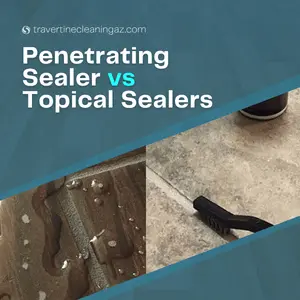
Penetrating Sealer vs Topical Sealers
Not all travertine sealers protect the same. Picking the right sealer matters just as much as when you apply it.
Penetrating sealer
A penetrating sealer soaks in and protects from within. It does not change the look, does not peel, and lets the stone breathe. This is what we use at AriStone, and we back it with a 2 year warranty. If you want a richer, wet look on outdoor travertine, we also offer enhancing sealers.
Topical sealers
Topical sealers sit on top of the stone like a coating. They can look good at first, but in Arizona sun they tend to cloud, flake, and peel, and removing a failed topical sealer is far more work than sealing correctly in the first place. We generally steer people away from them.
Sealing is only half the job
Sealer should never go down over a dirty floor. Deep cleaning comes first, because sealing traps whatever is already in the stone.
Our travertine cleaning process uses an alkaline solution, a dwell period, then power washing with hot water at roughly 1200 PSI and 250 degrees, followed by 17 inch rotary scrubbers. Only after the tile cleaning is done does the sealer go on.
Sealing, Polishing and Restoration Are Not the Same Thing
People often use these terms interchangeably, so here is how travertine care actually breaks down.
Regular cleaning at home. Weekly. Removes surface dirt with a pH-neutral cleaner.
Professional travertine cleaning. Every 1 to 2 years. Pulls out embedded dirt that mopping simply cannot reach.
Travertine cleaning and sealing. About every 2 years. Deep cleaning followed by a fresh penetrating sealer.
Professional restoration. As needed. Hole filling, repairs, and full refinishing of damaged travertine.
Most travertine surfaces in Arizona homes only need cleaning and sealing on a regular cycle. Polishing comes around far less often, and full professional restoration is reserved for floors that have been neglected long enough to need real repair work.
Sweep or dust mop often. Grit is what grinds down a sealer in high-traffic areas.
Use a pH-neutral stone cleaner. Our roundup of the best products for travertine tile flooring covers what is safe. Skip vinegar, bleach, citrus cleaners, and anything acidic.
Wipe spills quickly, especially wine, coffee, and juice.
Place mats at entrances to catch sand and debris before they reach the travertine tile.
Use coasters and trays on travertine countertops and outdoor surfaces.
Aim sprinklers away from outdoor travertine to cut down on mineral deposits.
Rinse pool deck areas now and then so chemicals do not sit on the stone.
None of this replaces professional sealing, but proper maintenance can genuinely stretch a two-year cycle closer to three.
Can You Reseal Travertine Yourself?
Yes, it is possible, and many homeowners do a great job of it. The challenge usually lies in the preparation. Applying a sealer to a poorly cleaned floor traps dirt inside the stone.
Using the wrong product, leaving excess sealer on the surface, or failing to allow sufficient drying time can lead to issues that are more costly to fix than simply doing the job right the first time.
A professional service handles the cleaning, the correct product for your specific stone, even coverage and proper cure time. If you are weighing it up, our guide on DIY versus professional tile and grout cleaning walks through the honest tradeoffs.
Key Takeaways
The short version of how often to reseal travertine floors in Phoenix AZ.
Indoor travertine floors: reseal about every 2 years under normal foot traffic.
Outdoor travertine, outdoor pavers and pool deck areas: reseal every 1 to 2 years, and closer to yearly around a pool.
The 5-minute water test settles it. If water soaks in and darkens the stone within five minutes, your travertine is due for professional sealing.
Arizona's climate shortens the cycle. Extreme heat, UV, monsoon dust, and mineral-rich water all wear a sealer down faster than a milder climate would.
Use a penetrating sealer, not topical sealers. It protects from within, keeps the stone's natural appearance, and will not cloud or peel in the sun.
Always clean before sealing. Sealing over embedded dirt permanently locks it into the porous stone.
Sealing is not polishing. Travertine polishing and honing are done every 5 to 7 years, and professional restoration is only performed when the stone is truly damaged.
Proper maintenance buys you time. Sweeping often, skipping harsh chemicals and acidic substances, and wiping spills quickly can stretch a 2-year cycle closer to 3.
Not Sure When Your Floors Were Last Sealed?
Most people do not know, and that is normal. We will look at your travertine, tell you honestly if it is due, and give you a straight answer on what it needs.
Now that you know how often to reseal travertine floors in Phoenix, AZ, the only thing left is to find out where your floors stand.
Frequently Asked Questions
How do I know if my travertine floor needs resealing?
Pour a little water on the stone and wait five minutes. If it beads up, your sealer is fine. If the water soaks in and darkens the travertine within five minutes, it is time to reseal. Dull patches, water spots that will not wipe away, and stains that set fast are other signs.
Does outdoor travertine need sealing more often than indoor floors?
Yes. Outdoor travertine, pavers, and pool deck areas are exposed to direct UV, extreme heat, and monsoon rain, so they usually need sealing every 1 to 2 years. Indoor travertine floors generally hold up for around 2 years.
What kind of sealer should be used on travertine in Arizona?
A penetrating sealer. It absorbs into the porous stone and protects from within without changing the stone's natural appearance, and it will not peel or cloud in the sun. Topical sealers sit on the surface and tend to fail in Arizona's climate.
Can travertine be sealed without cleaning it first?
It should not be. Sealing over embedded dirt traps it in the stone permanently. Professional cleaning always comes before sealing so the sealer bonds properly, and the stone's natural beauty shows through.
How long does travertine sealing take to dry?
Most penetrating sealers need about 24 hours to cure fully before heavy use. If hole filling with epoxy resin is part of the job, that portion needs roughly 12 hours to dry.
How often should travertine be polished?
Travertine polishing and honing are typically needed every 5 to 7 years, depending on the finish you want and how much wear the floor sees. That is separate from cleaning and sealing, which happen far more often.
Industry: Natural Stone, Tile and Grout Cleaning and Restoration
Cody has been in the Natural Stone, Tile and Grout service for 27 years, his knowledge and experience in this field helps get your job done correct the first time. If there is anyone you want on your job site it's Cody.