Understanding what type of travertine tile and the grade of it you have will help determine your overall care and maintenance.
When exploring the types of travertine tile, it’s important to understand how each variation of travertine tile differs in appearance, durability, and application. Travertine stone is widely used in both residential and commercial projects due to its versatility, natural texture, and timeless appeal.
Travertine is a very versatile type of stone that comes in different grades, types, and styles. It is good to know the differences between these different travertine categories because it will help you understand the different possible restorations that can be completed for your travertine tiles.
In many homes, travertine floor tiles are chosen for their durability and elegant look, while tumbled travertine tile is favored for rustic or outdoor settings.
Whether you're working with a travertine slab for countertops or installing travertine pavers outdoors, knowing the distinctions will help you make informed decisions.
Understanding Travertine Characteristics and Applications
Travertine marble is often compared to other natural stones because of its unique formation process and natural imperfections, which give it character. Depending on the finish and processing method, travertine can have a smooth surface or a more textured feel, such as brushed travertine or tumbled stone.
You’ll also notice a wide range of travertine tile colors and travertine colors, making it suitable for various design styles, from modern interiors to classic Mediterranean spaces. These materials are commonly used for bathroom floors, bathroom walls, kitchens, patios, and even edge travertine detailing for steps and borders.
Because travertine is a porous material, understanding the benefits of sealing your stone tile shower or bathroom walls is essential to preventing water damage and mold.
STYLES OF TRAVERTINE
We are going to start with the styles of travertine tiles. There are three main styles: tumbled, honed, and polished travertine. Travertine is a very versatile type of stone that comes in different grades, types, and styles.
It is good to know the differences between these different travertine categories because it will help you understand the different possible restorations that can be completed for your travertine tiles, helping you decide whether to fix or replace your stone.
TUMBLED TRAVERTINE
Tumbled Travertine is more of a rough, natural-looking style of travertine. The edges tend not to be straight, and there may be more pitting and rigidity to the surface of the tiles.
This style of travertine is the most natural-looking of the three. It has movement from all directions. Typically, you will find tumbled travertine in showers, spas, backsplashes, and outdoors. It is also popular as flooring in Spanish/Tuscan-style homes here in Arizona.
While a high shine is hard to accomplish here, you can still maintain its beauty by knowing the best products for travertine tile flooring to avoid damaging its unique texture.
When it comes to the types of sheens you can achieve on tumbled travertine, you are a little more limited. Many people love the high shine look, but unfortunately, that is hard to accomplish with the rougher exterior of tumbled travertine.
The highest sheen we recommend and offer to tumbled travertine is a semi-gloss sheen, but we recommend the satin finish to keep the unique look of tumbled travertine.
HONED TRAVERTINE
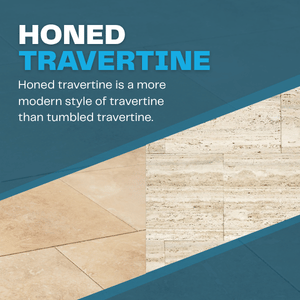
Honed travertine is a more modern style of travertine than tumbled travertine. This travertine style has a smoother finish with smooth edges and is typically factory-filled in the pits and holes.
Honed travertine is achieved by grinding one side of the travertine tile. Honed travertine is popular indoors as the flooring, in bathrooms, around pools, and in the kitchen as backsplashes. Honed travertine can be filled or unfilled, depending on the look you are going for.
Honed travertine can typically achieve any sheen from a satin finish to a high shine, depending on the grade of the travertine, which we will get to grades here shortly.
If you were looking for a higher sheen on your travertine and went with honed travertine, we suggest getting a higher-grade travertine to ensure the integrity of the polishing can occur.
If you notice your honed surfaces becoming dull or dirty over time, following pro tips for cleaning travertine can help restore that modern look.
POLISHED TRAVERTINE
Polished travertine is one of the most popular styles. This classy, modern, and sophisticated look gives a high-end feeling and a very luxurious feeling. Like honed travertine, polished travertine is ground on one side with abrasive grits to achieve a shiny finish.
However, because highly polished surfaces can become slippery, we recommend expert travertine cleaning and sealing to maintain the surface's grip and clarity without using dangerous topical coatings.
Polished travertine can be found in almost any atmosphere. Still, we suggest straying away from polished travertine, where water is often present, as it can get slippery when highly polished.
It typically comes in a semi-gloss finish or the high shine finish and is very easy to get back to those sheens if, over time, they dull.
With polished travertine, achieving the highest shine possible is always the best route, as this travertine style is already prepped for that sheen.
We do not recommend applying a topical sealer to any form of travertine to make it even shinier, as that topical will break down and look bad over time, and can hurt the integrity of your polished travertine.
Beyond the primary styles, there are several travertine finishes available that influence both appearance and functionality. A honed finish offers a matte look, while brushed travertine enhances the stone’s natural texture for a more organic feel.
Design options such as patterned travertine layouts can elevate visual appeal, especially in larger spaces. Meanwhile, unfilled travertine tiles highlight the stone’s raw beauty, showcasing its natural imperfections for a more authentic aesthetic.
Regardless of the finish, all travertine is susceptible to certain liquids; being aware of common things that stain travertine can help you protect your investment.
GRADES OF TRAVERTINE
The next important thing to know about your travertine is its grade level. There are three grades of travertine: premium, standard, and commercial. They all vary slightly, but they can have an impact on what can be achieved once installed.
PREMIUM OR FIRST GRADE
This grade tends to be the highest level of the grades. When produced, it is cut with the most even thickness, has very little filler, and is the most uniform in look.
First-grade travertine also comes in the most color variations, and the tiles are double-filled to ensure the highest grade. This grade tends to be the easiest to polish to all the sheens, including the highest of shines.
STANDARD OR SECOND GRADE
Standard grade is also cut uniform in thickness but there will tend to be more filling needed. These tend to be honed styles of travertine.
The fill is double-filled, but some of the filled areas will be the entire thickness of the stone, and the filled areas may be more prominent and more noticeable.
Commercial grade tends to be more uneven, is not cut perfectly in thickness, and will have more fill variation. This grade is only factory-filled and not hand-filled before distribution, so small pits and holes may be found at the time of installation.
Third-grade tiles tend to be what tumbled travertine is designated within. The higher sheens will be hard to achieve, and this grade is more of a natural stone look and a more rustic feeling.
As you can see, the different grades have different characteristics to help you choose the best options for you and the look you are going for. We are not stating that one grade or type is better.
There are just different things and looks you can achieve with them. Also, we want you to know where to use them and not use them to help keep your surfaces bright and looking their best.
How To Choose the Right Grade for Your Project
Selecting the right grade, especially the premium grade, depends on your application. Higher grades are ideal for indoor travertine floors and polished surfaces, while lower grades may be better suited for outdoor or rustic designs where variation is acceptable.
TYPES OF TRAVERTINE TILE
Last but not least, let's discuss the types of travertine. This part is more fun than anything because all the different styles and grades can have these types found within them. There are two cut types to travertine vein and fleuri. The cut type is determined by the bedding planes of the travertine.
VEIN CUT TRAVERTINE
You achieve a vein cut when you cut against the bedding, giving the travertine surface a linear pattern look.
FLEURI CUT TRAVERTINE
This is cross-cutting against the bedding, giving you a more circular-looking or non-consistent pattern to the travertine.
Both of these cuts are beautiful and give the travertine a more distinct feeling and look you may be going for. We hope this helps you choose what style, grade, or type of travertine for your next project.
Industry: Natural Stone, Tile and Grout Cleaning and Restoration
Cody has been in the Natural Stone, Tile and Grout service for 27 years, his knowledge and experience in this field helps get your job done correct the first time. If there is anyone you want on your job site it's Cody.